Showing posts with label Beauty. Show all posts

Monday, January 24, 2011

It's a Beautiful World

Today I discovered a wonderful Plog (picture blog) posted on Denverpost.com which shares incredible historical photography.  I was especially transfixed by the pre-World War I color photographs from Russia.  Since I will probably never visit Russia and obviously I will never visit the early 1900s in person, I am grateful to visit the country and the time through these amazing photos.

The photographs of Russian chemist and photographer, Sergei Mikhailovich Prokudin-Gorskii, show Russia on the eve of World War I and the coming of the revolution. From 1909-1912 and again in 1915, Prokudin-Gorskii travelled across the Russian Empire, documenting life, landscapes and the work of Russain people. His images were to be a photographic survey of the time.

He travelled in a special train car transformed into a dark room to process his special process of creating color images, a technology that was in its infancy in the early 1900’s. Prokudin-Gorskii left Russia in 1918, after the Russian Revolution had destroyed the Empire he spent years documenting. To learn more about the Prokudin-Gorskii, the process he used to create the color photographs, and see his collection, you can visit the Library of Congress, who purchased his glass negatives in 1948 after his death in 1944.

Here is a sampling of what you will find.  Enjoy.


Peasant girls, Russian Empire. Three young women offer berries to visitors to their izba, a traditional wooden house, in a rural area along the Sheksna River, near the town of Kirillov; 1909 Sergei Mikhailovich Prokudin-Gorskii Collection (Library of Congress).

Mills in Ialutorovsk district of Tobolsk Province; 1912 Sergei Mikhailovich Prokudin-Gorskii Collection (Library of Congress).


Alim Khan, Emir of Bukhara, seated holding sword; between 1905 and 1915 Sergei Mikhailovich Prokudin-Gorskii Collection (Library of Congress).


Old church of Saint Nicholas the Wonder Worker, Nyrob; 1910 Sergei Mikhailovich Prokudin-Gorskii Collection (Library of Congress).

Group of workers harvesting tea. Greek women, Chakva; between 1905 and 1915 Sergei Mikhailovich Prokudin-Gorskii Collection (Library of Congress).


Altar side of the Dmitrievskii Cathedral, Vladimir; 1911 Sergei Mikhailovich Prokudin-Gorskii Collection (Library of Congress).


Isfandiyar, Khan of the Russian protectorate of Khorezm (Khiva), full-length portrait, in uniform, seated on chair, outdoors; between 1910 and 1915 Sergei Mikhailovich Prokudin-Gorskii Collection (Library of Congress).

Dagestani types, Group of women posed outdoors; between 1905 and 1915 Sergei Mikhailovich Prokudin-Gorskii Collection (Library of Congress).
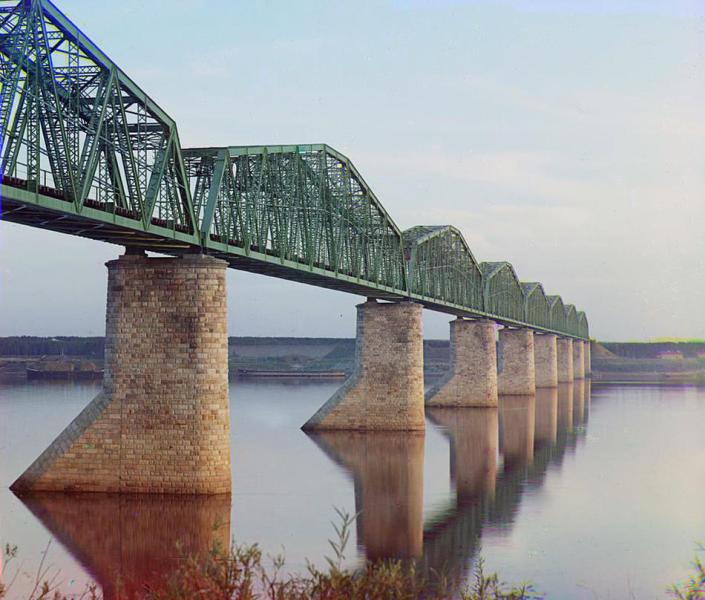


Trans-Siberian Railway metal truss bridge on stone piers,
over the Kama River near Perm, Ural Mountains Region;
ca. 1910 Sergei Mikhailovich Prokudin-Gorskii Collection (Library of Congress).

Thank you, Sergei Mikhailovich Prokudin-Gorskii, for documenting your world and preserving your work so it can be viewed in different land in another century.

Is there something beautiful or important you will leave to the next generation? Something that will express your world, your personality, your interests?  What will you leave as your statement?


Wednesday, May 12, 2010

Something To Think About . . .

THE SITUATION

In Washington, D.C., at a Metro Station, on a cold January morning in 2007, this man with a violin played six Bach pieces for about 45 minutes. During that time, approximately 2,000 people went through the station, most of them on their way to work. After about 3 minutes, a middle-aged man noticed that there was a musician playing. He slowed his pace and stopped for a few seconds, and then he hurried on to meet his schedule.


About 4 minutes later:

The violinist received his first dollar. A woman threw money in the hat and, without stopping, continued to walk.


At 6 minutes:

A young man leaned against the wall to listen to him, then looked at his watch and started to walk again.

At 10 minutes:

A 3-year old boy stopped, but his mother tugged him along hurriedly. The kid stopped to look at the violinist again, but the mother pushed hard and the child continued to walk, turning his head the whole time. This action was repeated by several other children, but every parent - without exception - forced their children to move on quickly.

At 45 minutes:


The musician played continuously. Only 6 people stopped and listened for a short while. About 20 gave money but continued to walk at their normal pace. The man collected a total of $32.

After 1 hour:

He finished playing and silence took over. No one noticed and no one applauded. There was no recognition at all.


No one knew this, but the violinist was Joshua Bell, one of the greatest musicians in the world. He played one of the most intricate pieces ever written, with a violin worth $3.5 million dollars. Two days before, Joshua Bell sold-out a theater in Boston where the seats averaged $100 each to sit and listen to him play the same music.

This is a true story. Joshua Bell, playing incognito in the D.C. Metro Station, was organized by the Washington Post as part of a social experiment about perception, taste and people's priorities.


This experiment raised several questions:

  • In a common-place environment, at an inappropriate hour, do we perceive beauty?
  • If so, do we stop to appreciate it?
  • Do we recognize talent in an unexpected context?
One possible conclusion reached from this experiment could be this:


If we do not have a moment to stop and listen to one of the best musicians in the world, playing some of the finest music ever written, with one of the most beautiful instruments ever made . . .

How many other things are we missing as we rush through life?

Friday, February 05, 2010

Rice Paddy Art

Prepare to be amazed and surprised, as I was.

Stunning crop art has sprung up across rice fields in Japan, but this is no alien creation. The designs have been cleverly planted.

In 2005, agreements between landowners allowed the creation of enormous rice paddy art.

A year later, organizers used computers to precisely plot planting of the four differently colored rice varieties that bring the images to life. 


Farmers creating the huge displays use no ink or dye.  Instead, different color rice plants have been precisely and strategically arranged and grown in the paddy fields.

As summer progresses and the plants shoot up, the detailed artwork begins to emerge.


A Sengoku warrior on horseback has been created from hundreds of thousands of rice plants.


Napoleon on horseback can be seen from the skies.


.


The farmers create the murals by planting little purple and yellow-leafed Kodaimai rice along with their local green-leafed Tsugaru, a Roman variety, to create the colored patterns in the time between planting and harvesting in September.

The murals in Inakadate cover 15,000 square meters of paddy fields.

From ground level, the designs are invisible, and viewers have to climb the mock castle tower of the village office to get a glimpse of the work.

Closer to the image, the careful placement of the thousands of rice plants in the paddy fields can be seen.

Rice-paddy art was started there in 1993 as a local revitalization project, an idea that grew from meetings of the village committees. In the first nine years, the village office workers and local farmers grew a simple design of Mount Iwaki every year.

But their ideas grew more complicated and attracted more attention.

Creativity makes WORK joyful!

Wednesday, November 18, 2009

The Cracked Pot


An elderly Chinese woman had two large pots, each hung on the ends of a pole which she carried across her neck.

One of the pots had a crack in it while the other pot was perfect and always delivered a full portion of water.

At the end of the long walks from the stream to the house, the cracked pot arrived only half full.

For a full two years this went on daily, with the woman bringing home only one and a half pots of water..

Of course, the perfect pot was proud of its accomplishments.

But the poor cracked pot was ashamed of its own imperfection, and miserable that it could only do half of what it had been made to do.

After two years of what it perceived to be bitter failure, it spoke to the woman one day by the stream.

'I am ashamed of myself, because this crack in my side causes water to leak out all the way back to your house.'

The old woman smiled, 'Did you notice that there are flowers on your side of the path, but not on the other pot's side?'

'That's because I have always known about your flaw, so I planted flower seeds on your side of the path, and every day while we walk back, you water them.'

For two years I have been able to pick these beautiful flowers to decorate the table.

Without you being just the way you are, there would not be this beauty to grace the house.'

Each of us has our own unique flaw. But it's the cracks and flaws we each have that make our lives together so very interesting and rewarding.

You've just got to take each person for what they are and look for the good in them.

SO, to all of us cracked pots, have a great day and remember to smell the flowers on your side of the path!